

If you are just dipping your toes into the world of vaping, you might feel overwhelmed by all the phrases that you need to learn. Sub ohm devices, mesh coils, and box mods are far off in the future; let’s focus on the most important information that you need to learn to start your vape journey.
So, what is MTL vaping? And what is DTL vaping?
Why Do I Need to Know The Difference?
Forget all the other jargon, and focus on MTL and DTL. These are the two types of vaping styles. You need to master these before you start thinking about advanced kits, mods, and other types of e-liquids.
‘What is MTL vaping?’ and ‘what is DTL vaping?’ are common searches, especially for beginners. The answer is simple enough: they are both types of vaping. But these vaping styles dictate which devices you can buy, which e-liquid compositions are compatible with your devices, and which coils you can use.
Let’s jump right in and explore the differences between MTL and DTL vaping.
What is MTL Vaping?
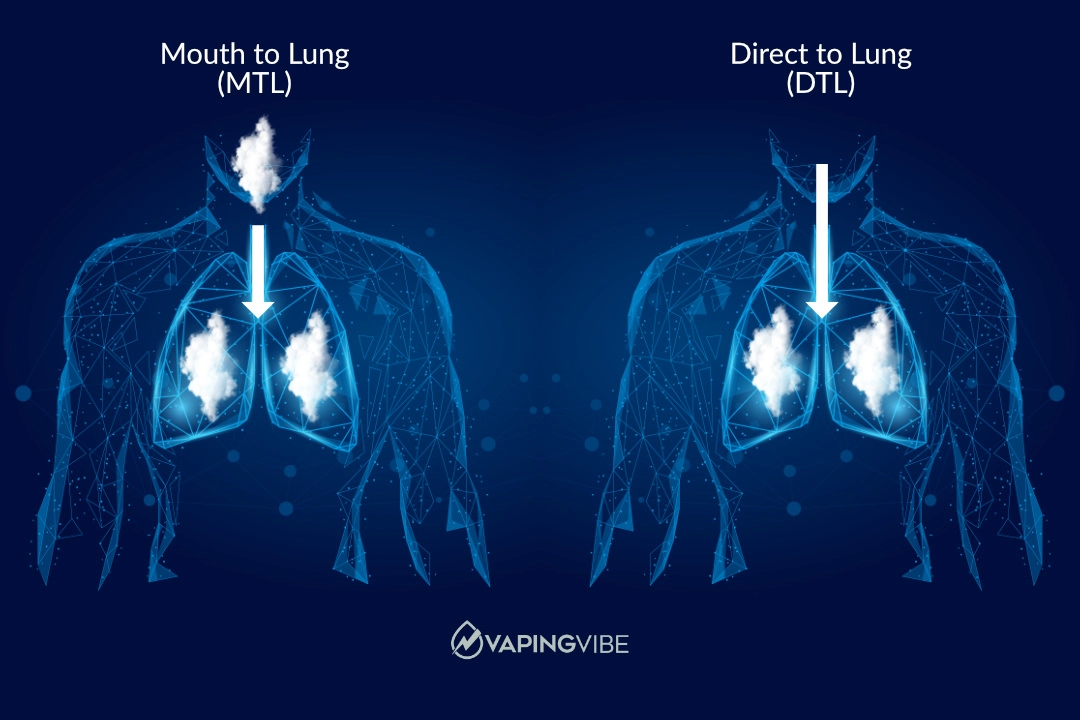
MTL stands for Mouth-to-Lung.
To take a MTL vape hit, you should draw on your device in short, sharp bursts. Hold the vapor in your mouth for a few moments to experience the throat hit. Once the throat hit has subsided, you need to draw the vapor into your lungs and exhale.
It really is as simple as that. If you have never vaped or smoked before, you might need to try MTL vaping a few times to master it. But if you are an ex-smoker you should have no problem with this style of vaping.
What Kind of Vapers Prefer MTL Vaping?
This style of vaping replicates the feeling of smoking a cigarette. The throat hit is very similar, which is why beginner vapers love MTL vaping. It allows ex-smokers to seamlessly switch between cigarettes and vape kits without giving up all the feelings associated with smoking cigarettes. Even advanced, experienced vapers stick to MTL vaping because it is the easiest way to vape.
MTL vaping promises intense throat hits. The higher the levels of nicotine in your e-liquid, the more intense your throat hit. If you need high levels of nicotine to satisfy your cravings, you will enjoy MTL vape hits far more than DTL vape hits.
What Devices And Coils Are Compatible With MTL Vaping?
The question ‘what is MTL vaping?’ is usually followed by ‘what devices are compatible with MTL vaping?’
If you prefer MTL vaping, you can choose from a wide range of devices. MTL vaping is the most popular type of vaping style, and it is compatible with most starter kits and kits that you can pick up off the shelf.
Starter kits typically have lower power outputs, and they contain or are compatible with coils that are over one ohm. All coils have an ohm level. The ohm level tells us the level of electrical resistance in the coil. Coils that are compatible with MTL kits are typically between 2.4 and 2.8 ohms.
Unsure of which device to buy for MTL vaping? No problem. Just remember this; you need a low-powered device that contains a coil with an ohm level above 2.
Read our list of the Best Vapes for Beginners to find modern MTL vape kits.
What E-Liquids Are Compatible With MTL Vaping?
All e-liquids have a few basic ingredients. VG (vegetable glycerin) and PG (propylene glycol) combine to form a basis for vape juice. Flavorings, nicotine, and water follow to make the finished product.
Vegetable glycerin is a colorless, thick liquid that creates dense clouds. Propylene glycol is another colorless liquid, but it is a lot thinner, and it guarantees full flavor. Manufacturers mix these ingredients in different ratios to cater to different kinds of vapers.
For MTL vapes, we recommend e-liquids that contain a higher ratio of PG. Most MTL vapers choose 50:50 e-liquids. This perfectly balanced ratio creates satisfying throat hits, and it even promises immense flavor. More PG equals thinner vape juice. Thin vape juice can get to your coil quicker and can soak into the wick more effectively, which means that you get to experience more of your favorite flavor profile.
Most e-liquid brands do not go above 50% PG, but some go as far as 70% PG. If you go too high, the throat hit might be too intense to handle.
You can even experiment with high VG mixtures and sub ohm coils, but you need to remember that VG is far more viscous than PG. If you use an e-liquid that contains more than 60% of VG you might clog your coil.
Other Benefits of MTL Vaping?
There is little to no learning curve associated with MTL vaping, which means that anyone can master it. Even the most trepidatory beginner can breeze past this stumbling block and start experimenting with e-liquid flavors and nicotine strengths.
Another big benefit of MTL vaping is that it uses less power and e-liquid than DTL vaping. MTL vapers take quick, brief draws on their devices, which means that their devices are activated for shorter periods of time, and less e-liquid is vaporized.
MTL vaping is the most popular vaping style, and it is compatible with the biggest range of devices. Devices that are made for MTL vaping are usually targeted toward beginner vapers, so they are less expensive than the advanced mods on the market.
What is DTL Vaping?
DTL stands for Direct to Lung.
To take a DTL vape hit, you have to draw on your device for three or more seconds. You need to be careful not to take short, sharp drags. Your draw needs to be smooth and consistent. Most vapers usually find that five seconds is enough to draw the vapor straight into their lungs, but some vapers push their limits to ten seconds.
Once you have hit your limit, you can exhale the vapor. DTL vapers enjoy making eye-catching plumes of vapor, and some even make a sport of it by competing to create the biggest vape rings.
This style of vaping replicates the process of breathing, but it is more difficult to master than MTL vaping. If you are accustomed to smoking traditional cigarettes you might struggle to switch to DTL vaping.
What Kind of Vapers Prefer DTL Vaping?
It is unusual for beginner vapers to jump straight into DTL vaping. This style of vaping is more common among experienced vapers who have a few years (or even just a few months) under their belts. Vapers have to overcome more of a learning curve to enjoy the benefits of DTL vaping.
If you are still attached to the feeling of smoking a cigarette, DTL vaping might not be for you. This kind of vape hit is reserved for people who have overcome their attachment to cigarettes and can appreciate thick plumes of vapor. Cloud chasers prefer DTL hits over MTL hits because they never have to compromise on vapor.
What Devices And Coils Are Compatible With DTL Vaping?
Now that we have answered the question ‘what is DTL vaping?’ we need to find out which devices are compatible.
DTL vaping is also known as sub ohm vaping. The term sub ohm refers to coils that have a resistance level under one ohm. These coils heat up faster, which means that they vaporize e-liquid quicker and produce more vapor. Kits that contain sub ohm coils produce dense, immense vapor. By pairing a sub ohm vape kit with a DTL draw, you can create unforgettable clouds.
The ideal sub ohm kit should have a wide 810 drip tip. This kind of tip allows vapers to inhale far more forcefully and draw more vapor into their lungs. Another thing to look out for is an adjustable airflow feature, which allows vapers to adjust their airflow to the maximum and inhale more vapor.
Check out our list of Recommended Sub Ohm Tanks.
What E-Liquids Are Compatible With DTL Vaping?
DTL vapers can satisfy their craving for clouds with high VG e-liquids. It is more common to find vape juices that contain higher percentages of VG. Whereas too much PG can create harsh, burnt-tasting e-liquid, there is no such thing as too much VG.
You can choose from lots of VG concentrations. Common high VG ratios contain 60%, 70%, and 80% VG. Some brands even create 100% VG liquids. But beware, this ratio leaves no room for PG, which boosts flavor.
Before you choose an e-liquid, you need to remember that VG is very thick. Remove the tank from your device and have a look at the wicking holes on the coil. Are the coils small, or average? If the holes are small you should avoid e-liquids that contain higher concentrations of VG, because your coil will struggle to pull the liquid through. If the holes are on the bigger side, buy whichever VG composition you want!
Cloud chasers love 70VG:30PG blends. This ratio produces high levels of vapor and contains just enough PG to highlight the intricacies of whatever flavor is in your tank.
Which Nicotine Strengths for MTL and DTL Vaping?
Nicotine strength might just seem like another piece of the puzzle, but it plays an important part in your overall vape experience. Just as you have to choose devices, e-liquids, and vaping styles that complement each other, you also have to choose the right nicotine strength.
Most e-liquid brands create juices that contain 0mg of nicotine, and the amount steadily increases up to the highest strengths. Vapers can use gradual nicotine increases as stepping stones to find their perfect vape hit. Choosing the wrong nicotine strength is not the end of the world, but if you consume more nicotine than you are accustomed to you could experience headaches and nausea.
MTL vaping is compatible with a range of nicotine strengths. If you are an ex-smoker, you can jump right in and choose a strength that matches the number of cigarettes that you smoked each day. A few cigarettes a day is equivalent to strengths on the lower end of the spectrum (3mg, 6mg), whereas ten or more cigarettes a day lands on the middle of the spectrum (10mg, 12mg). Higher amounts of nicotine (18mg, 20mg) are equivalent to twenty or more cigarettes a day.
DTL vaping is more compatible with lower nicotine strengths. For a DTL vape hit, you have to draw on your device continuously for anything from three to ten seconds. Even medium nicotine strength e-liquids (8mg, 10mg, 12mg) might be too harsh for this style of vaping. It all depends on your personal preferences, but we recommend choosing e-liquids that are on the lower end of the spectrum.
Main Differences Between MTL and DTL Vaping
When you pair these vaping styles with the right vape kits and e-liquids, you get two completely different outcomes.
- MTL vaping promises intense flavors and immense throat hits that are akin to the feeling of smoking a cigarette. DTL vaping promises thick, satisfying plumes of vapor and medium-strength flavors.
- DTL vaping is far more aesthetically pleasing than MTL vaping. This is a double-edged sword; DTL vape hits produce astounding amounts of vapor, but some vapers do not want to alert everyone to their presence. If you want a discreet vape hit between meetings or in a crowd of people, MTL vaping is the way to go.
- MTL vaping is the best option for people who need higher nicotine strengths. DTL vapers who try high nicotine e-liquids often experience burnt-tasting, overwhelming vape hits.
Wrapping Up
We hope that this article has helped you understand the difference between MTL and DTL vaping, and which option would be best for you. If you’re new to vaping, we recommend that you start with MTL devices and e-liquids. These products will give you a feel for how vaping works, and they help you control your nicotine consumption. If you want to delve into the world of sub-ohm vaping, check out our article on sub-ohm vaping for clouds and flavor.